
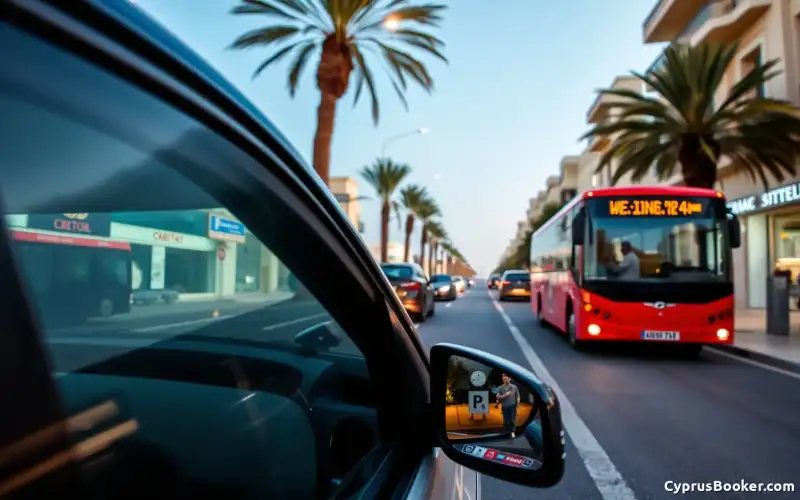
I watched a British couple argue for ten minutes outside Hertz on the main drag in Ayia Napa last June, debating whether to return their rental early. The wife wanted to keep it—freedom to hit Konnos Beach whenever. The husband wanted rid—he'd already scraped the wing mirror on a scooter and was sweating through his shirt at the thought of Cypriot roundabouts. By lunchtime, they'd made a decision that'll sound familiar to anyone planning a week in this corner of Cyprus.
Getting around Ayia Napa isn't complicated, but it's not straightforward either. You've got two main options: hire a car and navigate the island like a local, or stick with the buses and surrender some control in exchange for fewer headaches. The choice depends on what matters to you—cost, convenience, flexibility, or just wanting to avoid the stress of driving on the wrong side of the road.
1. The Real Cost Comparison: Car Hire vs Bus Fares
Let's start with money, because that's usually the deciding factor. Car hire in Ayia Napa in 2026 runs between €25 and €50 per day for a basic economy vehicle—a Hyundai i10 or similar. Book through the major companies (Hertz, Avis, Enterprise) and you're looking at the higher end. Use local operators or book ahead through comparison sites, and you might squeeze down to €20-30 daily. Add insurance (third-party is mandatory; comprehensive costs another €10-15 per day), and you're at roughly €35-65 per day all-in.
Fuel costs another layer. A litre of unleaded in Cyprus runs about €1.15-1.25 (2026 prices), and a week's driving around the island—say, day trips to Larnaca, Limassol, and the Karpas Peninsula—will burn through 40-50 litres easily. That's €50-65 in fuel alone. Parking in Ayia Napa town centre isn't free either; most seafront car parks charge €1.50-3 per hour, or €10-15 for a full day.
The bus, by contrast, is dirt cheap. A single journey on the local EMEL network costs €1.50. A week pass runs €15. If you're staying put and making occasional trips to nearby towns, you're spending maybe €20-30 for the entire week. Even if you take the bus every single day, you're under €25. The maths are brutal in the bus's favour if you're on a tight budget.
2. Freedom and Flexibility: Where Cars Win
But cost isn't everything. A car gives you something the bus doesn't: the ability to leave whenever you want, go wherever you want, and stay as long as you want. This matters more than you'd think in Ayia Napa.
Want to catch the sunset at Glyki Nero beach (about 8km south of town)? With a car, you jump in after your late lunch, drive there in ten minutes, and stay until the light dies. With a bus, you're checking timetables, waiting 20-30 minutes for the next service, and watching the clock because the last bus back runs around 6pm. The same applies to Konnos Beach, arguably the prettiest spot on the peninsula. It's accessible by bus (route 101 from the main station), but the service is infrequent, and you're tethered to schedules.
If you're planning proper beach days or want to explore beyond Ayia Napa—Larnaca's salt lakes, Limassol's old town, even a drive up to the Kyrenia Mountains—a car opens doors the bus simply can't. You set the pace. You decide when to stop for food, when to leave, when to backtrack. That freedom is worth something, especially if you're with a group and want to make spontaneous decisions.
3. Driving in Cyprus: What Brits Need to Know
Here's where it gets real. Cyprus drives on the left, which is good news if you're British. The bad news? Cypriot driving culture is... let's call it assertive. Speed limits are often treated as suggestions. Roundabouts are treated like dodgems. And parking is an art form that involves creative interpretations of what constitutes a legal space.
I've hired cars here dozens of times, and I'll be honest: the first hour is nerve-wracking. The roads are narrow in town, the drivers are impatient, and there's a lot of horn-honking. But it settles down once you get out of the main drag. The national roads (A3 towards Larnaca, A5 towards Limassol) are well-maintained and straightforward. Roundabouts follow standard rules, though locals will cut them tight and expect you to do the same.
Speed cameras are everywhere—literally, there are more speed cameras per kilometre in Cyprus than almost anywhere in Europe. The limit is 50kph in towns, 100kph on open roads, and 130kph on motorways. Exceed it by 10kph and you'll get a fine. Exceed it by 20kph and it's serious. They're not joking about this.
One thing that surprises Brits: you need an International Driving Permit (IDP) alongside your UK licence. This changed in 2021 and caught a lot of people out. Get one from Post Office before you leave—it costs £5.50 and takes five minutes. Without it, rental companies won't let you take the car, or they'll charge you a penalty.
4. The Parking Problem: Why Cars Can Be a Headache
Parking in Ayia Napa is the car hire equivalent of a hangover—it's the part nobody warns you about until you're living it. The town centre has a few official car parks, but they fill by mid-morning in summer. After that, you're hunting for street parking, which is either metered (€1.50-3 per hour, strictly enforced) or unmetered (and theoretically illegal, though locals seem to ignore this).
The seafront hotels have their own car parks, usually included for guests, but if you're staying in a villa or apartment without dedicated parking, you're looking at either paying daily rates or playing the street-parking lottery. I've seen people circle the same blocks for 20 minutes looking for a spot, burning fuel and patience in equal measure.
If you're planning to go clubbing at night—and let's face it, that's half the reason people come here—you can't drive. So you're either paying for a taxi (€8-15 depending on distance), using Uber (which operates here, though less reliably than in the UK), or pre-booking a minibus with your group. That negates some of the cost advantage of the car.
5. Bus Routes and Reliability: The Practical Reality
The local bus network (EMEL) covers the main routes: Ayia Napa to Larnaca (route 101), Ayia Napa to Limassol (route 110), and various local loops around town. The buses themselves are modern, air-conditioned, and usually on time. The main station is central, on Makedonias Street, about a five-minute walk from the seafront.
Summer timetables (May to September) run frequent services—buses every 30-45 minutes on main routes, sometimes more often. Winter (October to April) is thinner, but still reasonable. The real limitation is flexibility. If you miss a bus, the next one might be in 45 minutes. If you want to stay at a beach an extra hour, you're checking your phone for the return timetable and stressing about missing the last service.
That said, buses are reliable for day trips. A journey to Larnaca takes about 45 minutes and costs €5 return. Limassol is 90 minutes and costs €8 return. If you're planning structured outings—a museum visit, a specific restaurant dinner, a guided tour—the bus works fine. You're not dependent on parking, you're not navigating unfamiliar roads, and you can relax instead of concentrating.
6. Reaching Beaches: Car vs Bus Reality
This is where the decision really matters. Ayia Napa has beaches within walking distance of town (Nissi Beach, Landa Beach), but the better spots require transport. Konnos Beach, about 10km away, is stunning—crystal water, golden sand, far fewer crowds than Nissi. By car, you're there in 12 minutes. By bus, you're looking at 35-45 minutes with a walk at the end. Glyki Nero is even more remote; the beach access road is barely signposted, and public transport doesn't really serve it. You need a car to get there comfortably.
If beach variety matters to you—and it should, because Ayia Napa's town beaches get rammed in high season—a car is genuinely worth considering just for this reason. You can hit three different beaches in a day. By bus, you're lucky to manage two.
7. The Group Factor: How Many of You Are Traveling?
This changes the maths significantly. If you're a couple, a car costs €35-50 per day split two ways: €17-25 per person. If you're four people, it's €8-12 per person. If you're six, it's €5-8 per person. Suddenly, it's competitive with the bus, especially when you factor in the convenience.
Groups also split fuel costs. And groups are exactly the kind of travelers who benefit from flexibility—you want to make spontaneous decisions, change plans, and explore. A minibus hire for a group of 8-12 people costs about €60-80 per day (split that way, it's £5-7 per person), and you get a driver who knows the roads and handles the stress. That's genuinely worth considering if you're a large group.
Bonus Tip: The Hybrid Approach
Here's what actually works best: hire a car for 2-3 days to explore the island (Larnaca, Limassol, Karpas Peninsula), then use the bus for local trips and town centre stuff. This gives you flexibility without the daily cost burden. Or, if you're staying in a villa outside town, hire a car for the week—the daily cost is lower if you book a full week, and you'll use it constantly. But if you're in a seafront hotel and planning mostly beach days and nights out, skip the car and use the bus plus taxis for clubbing.
The couple arguing outside Hertz? They kept the car. But they only used it for three days, then returned it early and switched to buses. They saved money and stress. Sometimes that's the answer: you don't have to choose one or the other for the whole week.
The Verdict
Choose a car if you want flexibility, plan to explore beyond Ayia Napa, are traveling in a group, or want easy access to remote beaches. Choose the bus if you're on a tight budget, staying close to town, or don't fancy the stress of driving in an unfamiliar country. Both work. Neither is a disaster. It just depends on what kind of holiday you want.



Comments (5 comments)