The Reality of Working Remote from Ayia Napa: What You Actually Need to Know
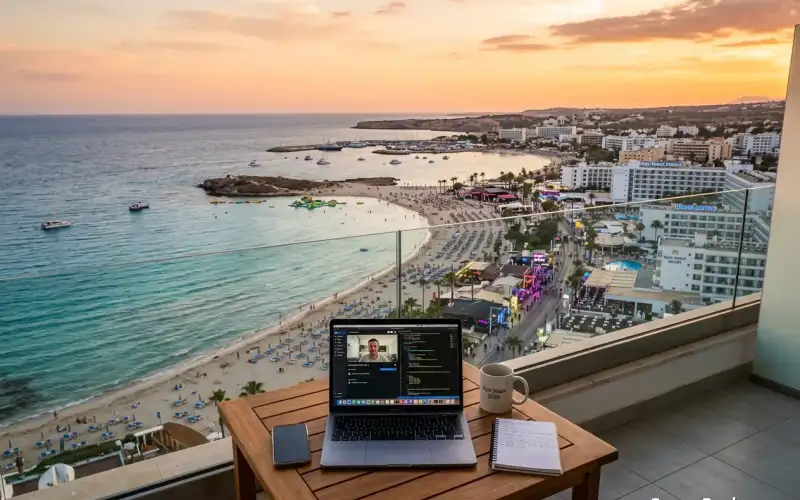
Last spring, I watched a British couple set up their laptops at a taverna table overlooking Nissi Beach, espresso cooling beside their keyboards, and I thought: this is the fantasy. Three hours later, one of them was cursing the WiFi drop and the other was explaining to their London boss why the Zoom call kept freezing. That's the honest version of remote work in Ayia Napa—it's brilliant when it works, but it requires planning.
Cyprus has quietly become one of Europe's most accessible places for UK remote workers. The island offers a digital nomad visa, genuinely cheap living compared to London, and more sunshine than you'll know what to do with. But there's paperwork involved, tax complications lurking, and some critical decisions about where you'll actually work when the beach WiFi fails you.
This guide walks you through the actual steps to set yourself up legally and practically in Ayia Napa as a British remote worker in 2026. We're talking visa applications, monthly costs in real numbers, where to find reliable internet, and—most importantly—how not to accidentally trigger UK tax residency issues that'll bite you later.
Prerequisites: What You Need Before You Arrive
Legal Status and Visa Requirements
Here's the first thing: the Cyprus digital nomad visa exists, but it's not automatic just because you're British. You need to apply for it before you arrive, not after. The official name is the "Digital Nomad Residence Permit," and as of 2026, it requires proof of monthly income of €2,500 or more (roughly £2,100). This applies whether you're self-employed, a contractor, or a remote employee for a UK company.
The application goes through the Cyprus Civil Registry and Migrant Services, and you'll need documents including a valid passport, proof of income (bank statements, employment contract, or tax returns), proof of accommodation in Cyprus, and private health insurance. The permit costs €70 and lasts one year, renewable. Processing takes around 20 working days if you apply online.
One critical detail: you cannot work for a Cyprus-based employer on this visa. It's specifically for people working remotely for companies or clients outside Cyprus. If your UK client or employer is based in Cyprus, you'll need a different visa category.
Financial and Tax Considerations
Before you pack, understand this: having a digital nomad visa does not automatically protect you from UK tax residency. HMRC uses something called the "Statutory Residence Test" (SRT), and it's more complicated than most people think. If you spend more than 90 days in the UK in a tax year, or more than 16 days in the UK while spending 91+ days abroad, you're potentially still UK tax resident. Being in Cyprus doesn't change your UK tax obligations unless you're genuinely non-resident under SRT.
You'll need a UK accountant who understands digital nomad tax situations. This isn't optional if you're earning substantial income. Budget £400–800 per year for proper tax advice. The Cyprus tax authority (CTO) also has its own residency rules—you become Cyprus tax resident after 183 days in the calendar year, but that's actually helpful for UK workers because Cyprus has tax treaties that prevent double taxation.
Income and Bank Account Essentials
Your UK bank account and payment processors need to handle international transfers smoothly. Most UK banks accept digital nomad visas as proof of address for account purposes, but notify them you're working abroad to avoid fraud blocks. Consider opening a Cyprus bank account once you're resident—it makes local payments easier. Alternatively, services like Wise or Revolut handle international transfers without the fees your high street bank will charge.
Ensure your income meets the €2,500 monthly threshold consistently. If you're a freelancer with variable income, you'll need to show average income over recent months, not just one month's peak. Document everything: bank statements, invoices, contracts. The Cyprus immigration system is straightforward but thorough.
Step 1: Apply for Your Digital Nomad Visa Before Departure
Start this process at least six weeks before you plan to move. Visit the Cyprus Civil Registry and Migrant Services website (migrant.gov.cy) and download the application form for the Digital Nomad Residence Permit. You'll need to complete it in English or have it officially translated if you're using another language.
Gather your documents: valid passport (minimum six months validity), proof of monthly income (last three months of bank statements showing regular income, or an employment contract with salary details), proof of accommodation (rental agreement, booking confirmation, or property ownership documents), and private health insurance coverage for Cyprus. The insurance must be valid for the entire permit period and cover at least €30,000 in medical expenses.
Submit the application online through the portal or in person at a Cyprus immigration office. The fee is €70, payable by card. You'll receive a reference number and estimated processing date. Most applications are processed within 20 days, but allow 30 days to be safe. Once approved, you'll receive a digital nomad residence permit card, which you collect in person at the immigration office in Larnaca or Paphos (Ayia Napa falls under Larnaca district).
Step 2: Secure Reliable Accommodation with Stable Broadband
This is where most remote workers get it wrong. They book a beachfront studio because it's cheap and picturesque, then discover the WiFi drops every afternoon when the local school gets out. Your accommodation choice directly affects your work productivity.
In Ayia Napa, you have three realistic options for remote work accommodation: serviced apartments with guaranteed broadband (€600–900 per month), private villa rentals with fibre connection (€700–1,200), or co-living spaces designed for digital nomads (€800–1,100). Avoid traditional holiday lets unless the listing explicitly confirms fibre broadband and provides speed test results.
When you're viewing or booking, ask specific questions: What's the broadband speed (upload and download)? Is it fibre or copper? Is there a backup mobile hotspot? What's the landlord's response time for technical issues? Request a speed test screenshot—anything under 10 Mbps upload is risky for video calls. The main providers in Ayia Napa are Cyta (state-owned, generally reliable), Vodafone, and Altec. Fibre connections in central Ayia Napa typically deliver 50–100 Mbps, which is solid.
Budget €750 monthly for a one-bedroom apartment with proper broadband. This includes utilities. Cheaper options exist, but they often compromise on internet reliability, and that's a false economy when your income depends on connectivity.
Step 3: Register with Cyprus Tax Authority and Set Up UK Tax Compliance
Once you're in Cyprus and settled, register with the Cyprus Tax Office (CTO) within 30 days of arrival. You'll need your passport, proof of address, and details of your income. Registration is free and straightforward—most accountants handle it for you. This establishes you as a tax resident for Cyprus purposes, which triggers certain obligations but also protects you from double taxation.
Simultaneously, contact a UK accountant who specializes in expatriates and digital nomads. They'll help you determine your UK tax residency status under the SRT. If you're non-resident, you only pay UK tax on UK-sourced income (not your remote work for non-UK clients). If you're still resident, you pay UK tax on worldwide income, though Cyprus tax treaties prevent double taxation on Cyprus-sourced income.
Keep meticulous records: invoices, bank statements, expense receipts, and a log of days spent in the UK versus Cyprus. This is tedious but essential. HMRC audits digital nomads more frequently than traditional employees, partly because the rules are misunderstood and partly because the numbers are increasing.
Step 4: Choose Your Working Base—Home, Co-working, or Hybrid
Working from your flat is fine for email and focused tasks, but video calls, client meetings, and concentration require different environments. Ayia Napa has two dedicated co-working spaces worth considering.
The Spot Coworking (central Ayia Napa, near Nissi Avenue) offers hot desks at €15 per day, dedicated desks at €250 monthly, and private office spaces from €600. They provide reliable 100 Mbps fibre, meeting rooms, kitchen facilities, and a genuine community of remote workers. It's popular with freelancers and small teams. Membership includes networking events and occasional skill-sharing sessions.
Workspace Ayia Napa (near the marina) charges €12 per day for hot desks, €200 monthly for dedicated desks, and has excellent natural light and a quieter atmosphere than The Spot. They're smaller, which some people prefer. Both spaces offer day passes if you want to test before committing.
Realistically, most remote workers use a hybrid approach: work from home 3–4 days weekly, use co-working 1–2 days for focus and social interaction. This costs €50–100 monthly and dramatically improves productivity and mental health. The co-working spaces also provide visa-friendly address confirmation if your accommodation landlord is reluctant to provide official documentation.
Step 5: Manage Your UK Financial and Tax Obligations Continuously
This isn't a one-time step—it's ongoing. File your UK tax return on schedule (January 31st deadline for self-assessment). If you're employed by a UK company, ensure your employer is processing your tax correctly; many don't understand digital nomad situations and may over-withhold.
File your Cyprus tax return if you're resident (by March 31st annually). Even if you're not Cyprus resident, you may have reporting obligations depending on your income source. Keep your accountant updated on any changes: if you move back to the UK, if your income changes significantly, if you spend unexpected time in the UK.
Maintain separation between personal and business finances. Use a business bank account (Cyprus or UK) for all client payments and business expenses. This simplifies tax filing and protects you if HMRC ever questions your status.
Troubleshooting: Common Problems and Solutions
Internet Dropout During Critical Calls
Your landlord's fibre connection fails during a client presentation. Solution: maintain a backup mobile hotspot using a local Cyprus SIM (Vodafone or Cyta offer 20 GB monthly plans for €20–25). Test your backup connection weekly. Schedule critical calls during off-peak hours (before 2 PM) when network congestion is lower. If dropouts persist, escalate to your ISP within 48 hours—they're required to resolve faults within five working days.
Visa Application Delays
Your permit application is still processing after 25 days, and you're arriving in 10 days. Contact the Cyprus Civil Registry office directly (phone or in-person visit to Larnaca office). Processing delays are rare but happen during peak seasons (April–August). If your permit isn't approved before arrival, you can enter on a standard tourist visa and collect the permit once approved—you're legally covered as long as approval is in process.
Tax Residency Confusion
You're unsure whether you're UK or Cyprus tax resident, and conflicting advice from different accountants isn't helping. Request a formal Statutory Residence Test determination from HMRC (free service). Provide them with your days in the UK, days in Cyprus, and employment situation. They'll issue written confirmation of your status, which you can provide to both HMRC and the Cyprus tax authority. This takes 4–8 weeks but eliminates ambiguity.
The Practical Reality of Remote Work in Ayia Napa
Working from Ayia Napa is genuinely viable if you approach it methodically. The visa process is straightforward, the cost of living is low (€1,200–1,500 monthly for a comfortable life), and the weather is reliably excellent. You'll work from a flat with sea views, take lunch breaks at tavernas, and have genuine flexibility that UK-based remote work rarely offers.
The catch is that it requires administrative diligence. The visa paperwork, tax compliance, and ongoing documentation aren't glamorous, but they're non-negotiable. Ignore them, and you'll face complications that make the whole arrangement more stressful than staying in London.
Start your visa application now. Book accommodation with verified broadband. Find an accountant before you arrive. Use co-working spaces to maintain structure and community. Keep records meticulously. Do these things, and you'll have a genuinely excellent setup for remote work with 320 days of Mediterranean sun, proper food (I mean proper—the meze spreads alone justify the move), and a lifestyle that most UK workers can only dream about.
The logistics aren't complicated. They just require attention. That's the difference between remote work in Ayia Napa being a dream and being a sustainable, legal, and genuinely enjoyable way to live and work.


Comments (3 comments)