It's 10:47 a.m. on day three, and Charlotte's youngest has just discovered that the kids' club serves ice cream at 11 a.m. She's already dressed in her swimming costume despite being nowhere near water. Her older brother is negotiating with a staff member about whether he can sign up for the afternoon football activity and the water basketball. Their youngest is asleep on a sun lounger, having exhausted himself in the splash park at 7:30 a.m. This is Adams Beach Hotel in mid-June, and it's exactly what you'd expect: controlled chaos, decent facilities, British accents everywhere, and a buffet that somehow manages to be both extensive and unremarkable.
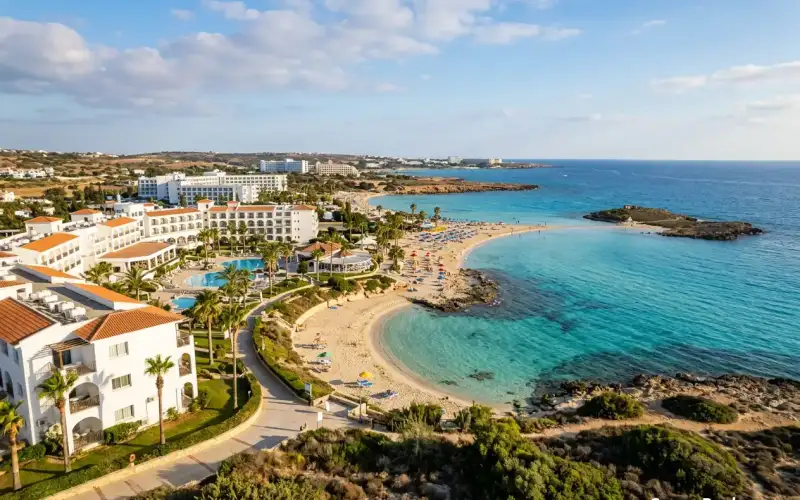
Adams Beach sits on the northern edge of Ayia Napa town centre, roughly 400 metres from the main strip of clubs and bars that British twenty-somethings frequent. The hotel occupies a prime beachfront position – not cliff-top, actual sand – and the beach itself is reasonable by Cypriot standards: gently shelving, mostly clean, with loungers and shade. For families, this location is deliberate. You're close enough to walk into town for fish and chips or a family-friendly taverna, far enough away that the 3 a.m. beats from Senor Frogs won't shake the walls of your room.
What the Brochure Promises vs What You Actually Get
The hotel markets itself as all-inclusive for families, which in 2026 means: room, breakfast, lunch, dinner, snacks, soft drinks, and kids' club activities included. Alcohol is not. A week's stay for a family of five (three children under 12) costs roughly £2,400–£3,100 depending on room category and season. That's per family, not per person. For comparison, a three-star hotel in Paphos with a car rental and restaurant meals would run £1,800–£2,200, but you'd be eating out constantly and managing logistics. Adams Beach removes that friction.
The kids' club operates daily from 9 a.m. to 1 p.m. and 3 p.m. to 6 p.m., with evening activities twice weekly. It's supervised by a mix of Cypriot and Eastern European staff, most of whom speak English well enough to manage crafts, games and basic conversation. The facilities include a dedicated activity room, a small splash park (more on this later), a beach volleyball court, and access to the main pool. Staff enforce a sign-in/sign-out system; you can't just abandon your child and hope for the best. That matters.
The Kids' Club: Reliable But Not Revolutionary
What Works
The kids' club is the reason most families book Adams Beach. It delivers on its basic promise: your children will be occupied, supervised, and returned to you fed and tired. The morning sessions (9 a.m.–1 p.m.) are structured around activities: crafts on Monday and Wednesday, water games on Tuesday and Thursday, football or basketball on Friday. The staff know the activities in advance and communicate changes via a whiteboard near the kids' club entrance. On one afternoon, the football activity was swapped for a beach treasure hunt because the court was being repaired. Staff notified parents by 2:45 p.m. – not ideal, but not chaotic either.
The afternoon sessions (3–6 p.m.) are looser: pool games, water volleyball, face painting, and ice cream at 5 p.m. (this is sacred; the ice cream arrives every single day at exactly 5 p.m., and the kids know it). Children aged 4–11 mix freely; older siblings can opt out, and the hotel doesn't pressure them to attend. One afternoon, Charlotte's eldest (14) chose to stay in the room, and nobody complained.
Meals for kids in the club are handled efficiently. Lunch is served at 12:15 p.m. in a dedicated section of the main restaurant. Food is standard Mediterranean-plus-British-comfort: pasta, chicken, fish, rice, salads, fruit. Nothing elaborate, but adequate. Kids with allergies are noted at check-in, and the kitchen staff do accommodate requests – though expect to repeat yourself.
Where It Falls Short
The kids' club staff are not trained childcare professionals. They're hospitality workers doing kids' activities. This is fine for ages 6–11, where supervision and basic engagement are the main goals. For younger children (4–5), it's less ideal. One mother mentioned her four-year-old was left unsupervised in the splash park for 15 minutes while staff dealt with a spilled drink. The staff weren't negligent – the child was safe – but they weren't hovering either.
The activities themselves are repetitive. Over seven days, the rotation is: crafts, water games, sports, repeat. There's no pottery, no Greek language lessons, no cooking class, no beach exploration. It's designed to tire children out, not enrich them. If your children are content with that, fine. If you're hoping for educational enrichment, adjust expectations.
Evening activities (offered on Wednesday and Saturday) consist of a quiz night or a disco in the kids' club room. The disco is 7–8:30 p.m., which is actually useful if you want to eat dinner in peace. But it's the same playlist, the same games, every week. One returning family joked that they could predict the exact moment "Baby Shark" would play.
The Splash Park: Small But Effective
The splash park is roughly 15 metres by 12 metres – not vast. It has a small waterslide, a tipping bucket, a water cannon, and shallow basins for toddlers. In peak summer (June–August), it's busy from 9 a.m. onwards, with queues for the slide by 10:30 a.m. Supervision is present but not intensive; staff monitor from the edge, and lifeguards are on duty, but it's not a dedicated aquatic facility.
The water is warm (around 28°C in June), and the depth is appropriate for ages 2–8. Older children find it tame. One father described it as "what you'd build in a back garden with a bit more budget." That's fair. It's not a water park in the Algarve sense. But for keeping young children occupied for 45 minutes while you drink coffee? It works.
One practical note: bring your own sun cream. The hotel sells it at reception for £12 per bottle, which is double the supermarket price. The splash park has no shade except umbrellas you've rented from the pool area (£3 per day).
Food: Quantity Over Quality
Breakfast
Breakfast is served 7–10 a.m. in the main dining room. It's a standard Mediterranean buffet: cereals, bread, pastries, cold meats, cheese, yoghurt, fruit, juice, coffee. Nothing exciting, but adequate. Toast is available if your child refuses everything else. On the first morning, Charlotte's youngest ate only a croissant and a banana. By day five, she'd expanded to include bread with ham. The kitchen staff don't judge.
Lunch and Dinner
The lunch and dinner buffets are the same – a rotating menu with one salad bar, one meat station, one fish station, one vegetable station, and one carbohydrate station. On Monday: moussaka, grilled chicken, fried fish. On Tuesday: pasta, meatballs, grilled sea bass. The rotation repeats weekly. If you're there for two weeks, you'll eat the same meals twice. The quality is consistent but uninspired. The moussaka is competent; the fish is adequately seasoned; the vegetables are slightly overcooked. It's not bad. It's just not memorable.
Portion sizes are large, and children can request smaller plates. The dessert selection includes baklava, fruit, ice cream, and chocolate mousse. The ice cream is the most popular item; children queue for it daily.
Snacks and Drinks
Snacks are available throughout the day: biscuits, fruit, juice at 11 a.m., ice cream at 5 p.m., and a light evening snack (usually bread and cheese) at 8 p.m. Soft drinks are unlimited – juice, cola, lemonade, water. Coffee and tea are available at breakfast and afternoon snack time. Alcohol is not included; a beer at the pool bar costs £3.50, wine £4.50 per glass. This is standard for Ayia Napa.
Rooms: Functional, Not Luxurious
Most family rooms sleep four to five people: two adults and two–three children. The standard setup is a double bed, two single beds, and a pull-out sofa. Rooms are roughly 30 square metres – tight with three children but workable. Air conditioning works; the bathroom is small but functional. There's no balcony in standard rooms; sea-view rooms (£400–£500 extra per week) have a small terrace.
Housekeeping comes daily; towels are changed daily; the room is cleaned and tidied. One minor complaint: the Wi-Fi is unreliable. It connects but frequently drops. If you need to work or stream content, bring a mobile hotspot.
The Beach and Pool
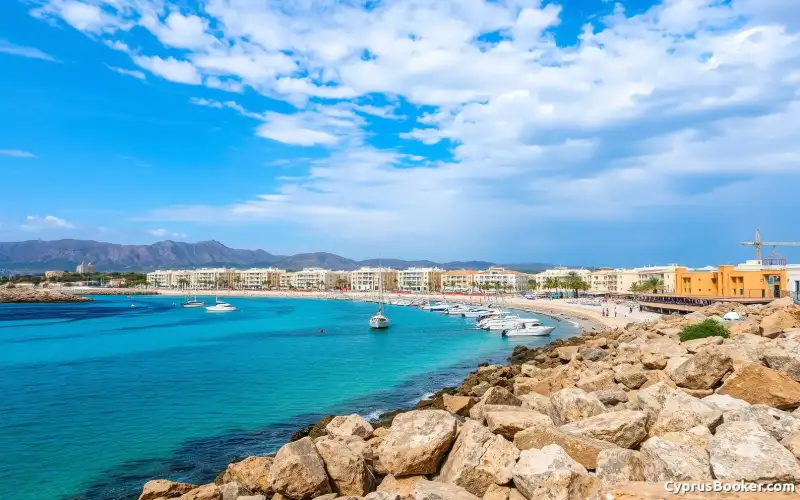
The beach is the hotel's main asset. It's 80 metres long and roughly 20 metres deep at the lounger line before dropping away. The sand is firm, the water is warm (27–29°C in summer), and there are no rocks or sea urchins. Loungers and umbrellas are free for hotel guests; the hotel provides roughly 100 loungers, and they fill by 8:30 a.m. in peak season.
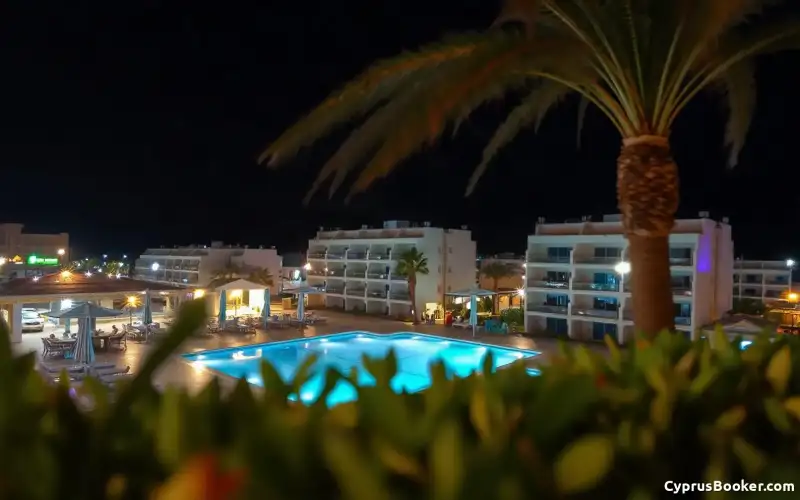
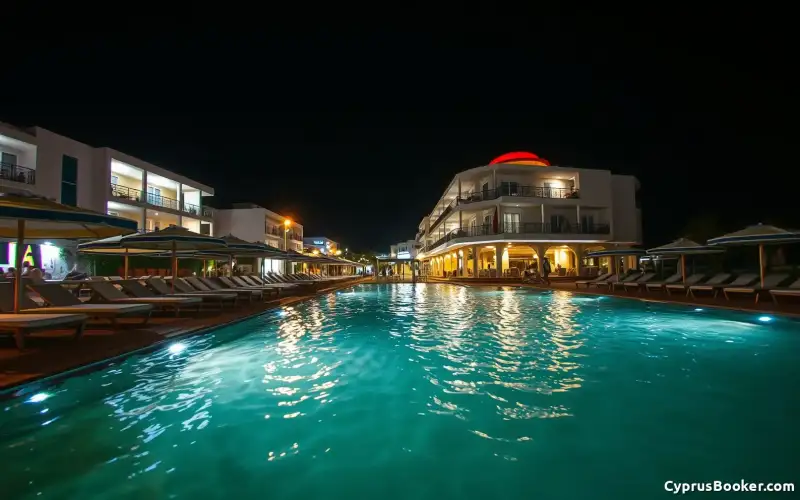
The main pool is Olympic-size (or close to it), with a shallow end and a deep end. There's a separate children's pool roughly 8 metres by 6 metres with a depth of 60 centimetres. Both are chlorinated and clean. The children's pool is warm (slightly warmer than the main pool) and crowded during kids' club hours.
One advantage: the hotel beach is quieter than the public beaches in central Ayia Napa. You won't have drunk twenty-somethings playing loud music 10 metres away. You will have organised families, the occasional couple, and the regular hotel staff. It's a trade-off, but for families, it's the right one.
Practical Details: Transfers, Money, Medical
The hotel offers airport transfers for £25 per adult, £15 per child (return). Taxis from Larnaca airport (45 miles away, 50–60 minutes) cost £45–£55 for a shared shuttle. If you hire a car (recommended if you want to explore beyond Ayia Napa), the hotel charges £12 per day for parking.
The nearest supermarket is 300 metres away (Alphamega, open 8 a.m.–9 p.m.). Prices are roughly 20% higher than UK supermarkets for imported goods (British breakfast cereal, Branston pickle), standard for tourist areas. The local taverna (Taverna Antonis, 200 metres along the beach) serves grilled fish and souvlaki for £12–£18 per plate – decent quality, friendly service.
Medical facilities: Ayia Napa has a private clinic (Dr. Demetriou, opposite the main square) with English-speaking doctors. A consultation costs £35–£50. The hotel reception can arrange appointments. No serious incidents during our stay, but one child had a mild ear infection, saw the doctor, and was prescribed antibiotics for £8. Standard European pharmacy prices.
Who This Hotel Is For (And Who It Isn't)
Best For:
- Families with children aged 4–11 (the kids' club sweet spot)
- First-time Cyprus visitors wanting all-inclusive simplicity
- British families who want familiar food and English-speaking staff
- Parents who want guaranteed child supervision for at least four hours daily
- Groups of families travelling together (the hotel has a family-friendly atmosphere)
Not Ideal For:
- Families seeking luxury or five-star amenities
- Those with teenagers (limited teen activities)
- Couples without children (you'll be surrounded by families)
- Adventurous eaters (the food is British-friendly, not authentic)
- People wanting to explore Cyprus beyond the beach (the location is central Ayia Napa, which is heavily touristy)
The Verdict: Worth It, With Caveats
Adams Beach Hotel is not the best family hotel in Cyprus – that's debatable, and depends on what you value. But it is reliable, and for British families with young children, reliability matters more than you'd think. The kids' club works. The food is adequate. The beach is good. The all-inclusive pricing removes the friction of constant decisions about where to eat and what activities to book.
At £2,400–£3,100 for a family of five for a week, it's competitive with mid-range package holidays. You're paying for convenience and supervision, not luxury or culinary excellence. If you're a parent who wants a week without constant logistical planning, and your children are aged 4–11, it delivers.
The cracks are real: the kids' club is repetitive, the food is uninspired, and the facilities are adequate rather than impressive. But nothing is broken. No staff are rude. No child is unsafe. No meal is inedible. It's honest, functional, and designed specifically for British families with money to spend and limited patience for complications. In that narrow category, it remains competitive, even in 2026.
Charlotte's youngest made it through the buffet without incident. All three children returned home tired and happy. The parents returned home exhausted but not regretful. That's the realistic measure of success at a family all-inclusive. Adams Beach delivers it.
Comments (3 comments)