
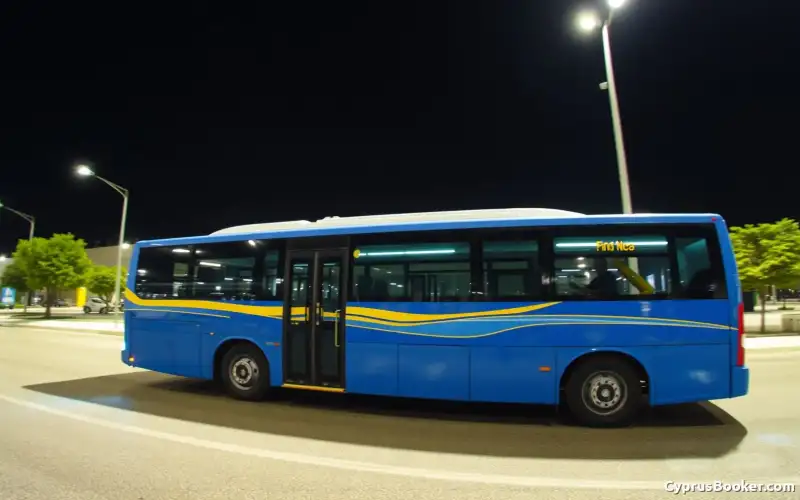
Last summer, I watched a family of four hand over €180 to a taxi driver outside Larnaca Airport while I queued with my three kids for the OSEA bus—and paid €5 total. The taxi pulled away, and my youngest asked why we were "sitting on the bus like poor people." I had to explain that we weren't poor, we were just smart. That's the moment I decided to write this guide, because nobody tells you that Cyprus has a functioning public bus system that actually works, or that you can get to Ayia Napa for less than a fancy coffee costs back home.
The Ayia Napa airport bus isn't glamorous. It's not a private transfer with your name on a sign. But it's reliable, it saves you a small fortune, and it gets you to your hotel without the anxiety of negotiating prices with a stranger who doesn't use a meter. If you're willing to spend 90 minutes on a coach instead of 45 in a taxi, you'll pocket £40-£50 per person—money that could buy your family actual holiday experiences instead of airport transport.
What You'll Learn in This Guide
By the end of this article, you'll know exactly how to navigate the OSEA bus system from Larnaca Airport to Ayia Napa in 2026. We'll cover the real timetables (not the ones that change weekly), where to actually board the bus when you're jetlagged and confused, how to handle luggage without losing your mind, and whether this option genuinely makes sense for your specific trip.
You'll also understand the differences between the various bus routes, what to expect at each stop, and exactly how much you'll save compared to a taxi or private transfer. I've done this journey roughly 15 times over three summers, and I've learned what works, what doesn't, and when you should probably just pay for a taxi instead.
This isn't a glossy travel guide telling you everything is wonderful. It's honest, practical advice from someone who's stood in the Larnaca Airport heat with three kids and a pushchair, trying to work out which bus goes where.
Prerequisites: What You Need Before You Start
Basic Requirements
- A valid ticket or enough cash (OSEA buses accept cash only—no card payments). Budget €5-€6 per person depending on which route you take.
- Small change, ideally. The drivers don't always have change for large notes, and you'll feel like a hero if you have exact coins.
- A clear head after your flight. Seriously, if you've had a rough journey, splurge on a taxi. Your sanity is worth something.
- Realistic luggage expectations. The bus isn't a luggage coach. You get one decent-sized suitcase per person, plus a small carry-on. If you're traveling with five cases and two pushchairs, you need a private transfer.
- About 90 minutes to spare. The bus stops everywhere—literally everywhere—between Larnaca and Ayia Napa. It's not express. It's "stopping to pick up Yiorgos and his shopping bag" slow.
- The knowledge that buses don't run on British time. They run on Cyprus time, which is a philosophical concept rather than a strict schedule.
Helpful Things to Have
- A screenshot of the OSEA route map saved to your phone (internet can be dodgy at the airport).
- Your hotel name and address written down, not just in your head. The driver might not speak English, but they'll recognize a written address.
- Euros, not pounds. You can't pay in sterling on OSEA buses, and the airport exchange rates are shocking.
- A sense of humor about travel delays and unexpected stops. This is Cyprus. Things happen when they happen.
- Comfortable shoes. You'll be standing in the airport, standing at the bus stop, and quite possibly standing on the bus for the first 20 minutes.
- A bag with snacks and water. The journey is long enough that your kids will get hungry, and there's nowhere to buy food once you leave the airport.
Step-by-Step: Getting From Larnaca Airport to Ayia Napa by Bus
Step 1: Exit the Airport and Find the Bus Station
When you walk out of arrivals at Larnaca Airport (officially Larnaka International Airport, though nobody calls it that), ignore the taxi drivers immediately. They'll swarm like seagulls at a beach café. Head to the left side of the terminal—not right, left—and look for signs saying "Bus Station" or "OSEA." It's roughly a five-minute walk from the main exit.
The bus station isn't fancy. It's essentially a covered area with benches and a small kiosk. You'll see several buses parked, and a board showing routes. Find the person working the kiosk (there usually is one, though they might be on a break—welcome to Cyprus). Ask for the bus to Ayia Napa. They'll direct you to the right bay.
If nobody's at the kiosk and you're panicking, look for the bus with Ayia Napa written on the destination board. There's usually only one or two routes heading that way, so you won't accidentally board the bus to Paphos and end up in the mountains.
Step 2: Understand the Route Options (There Are Two)
Here's the bit nobody explains: there are technically two ways to get to Ayia Napa by OSEA bus, and they're different enough that you need to know which one you're booking.
Route 1: The Direct-ish Route (Line 40). This leaves Larnaca Airport and heads northeast toward Ayia Napa, stopping at Athienou, Xylofagou, and Sotira before arriving in Ayia Napa town center. Journey time: approximately 90 minutes. Cost: €5 per person. This is the one most tourists use because it sounds faster.
Route 2: The Scenic Route (Line 30/35). This goes via Larnaca city center, which adds time but sometimes has better timetable options in the afternoon. Journey time: 110-130 minutes. Cost: €6 per person. Most families with young kids prefer Route 1 because it's shorter and there are fewer stops initially.
Ask the kiosk staff which route departs next and when. Write down the time. Don't rely on memory—you're jet-lagged, and time works differently when you're tired.
Step 3: Buy Your Tickets and Work Out the Timing
Walk up to the kiosk and say "Ayia Napa" clearly. They'll ask if you want Route 40 (most tourists do). Say yes. They'll tell you the departure time. As of 2026, the main departures from Larnaca Airport are roughly:
| Departure Time (Approx) | Route | Arrival in Ayia Napa | Cost per Person |
|---|---|---|---|
| 06:30 | Line 40 | 08:00 | €5 |
| 08:45 | Line 40 | 10:15 | €5 |
| 11:00 | Line 40 | 12:30 | €5 |
| 14:15 | Line 40 | 15:45 | €5 |
| 17:30 | Line 40 | 19:00 | €5 |
| 19:45 | Line 40 | 21:15 | €5 |
These times change seasonally and occasionally with no notice (welcome to Cyprus public transport). If your flight lands at 10:30, you might catch the 11:00 bus comfortably, or you might miss it by 10 minutes and wait until 14:15. Plan for buffer time. Airports are chaotic.
Pay in euros. The kiosk will give you a small paper ticket. Don't lose it—you might need to show it to the driver, depending on who's driving. Some drivers check, some don't. The system is relaxed.
Step 4: Board the Bus and Manage Your Luggage
When your bus arrives, the driver will open the luggage compartment underneath. Here's where you need to be strategic. Large suitcases go in the hold. Smaller bags, backpacks, and anything valuable stay with you on the bus. Your pushchair (if you have one) can go in the luggage hold, but you'll need to ask the driver first—they usually say yes, but they need to know.
Board from the front. The driver might take your ticket, or might not. Find a seat—preferably near a window so your kids can watch the countryside. If the bus is full (unlikely unless it's late afternoon), you'll be standing. It's not comfortable with luggage, but it's temporary.
Sit near the front if you have young children or if you're prone to bus sickness. The back of the bus bounces more, and Cyprus roads aren't always smooth.
Step 5: Know What to Expect During the Journey
The bus will stop at several towns on the way to Ayia Napa. These aren't rest stops—they're actual villages where locals board and exit. You'll stop at Xylofagou (about 30 minutes in), where several passengers will get off and others will get on. There's usually a small break here, maybe five minutes. If you need the toilet, there's a café-type place nearby, but the bus doesn't wait long.
The road between Larnaca and Ayia Napa is fairly modern but winding. It goes through rural countryside, and you'll see olive groves, small villages, and the occasional goat herd. It's actually quite pretty if you're not too exhausted to notice.
The bus has air conditioning, which is essential in summer. It works, but if you're sensitive to cold, bring a light layer. Cyprus buses run their AC like it's a punishment.
There's no toilet on the bus, and there are no scheduled rest stops specifically for that purpose. Plan accordingly. Most adults can manage 90 minutes, but if you're traveling with young children who need the toilet every 20 minutes, you might want to reconsider the bus option.
Step 6: Recognize Your Destination and Exit Properly
The bus arrives in Ayia Napa town center, near the harbor and the main square. The driver will announce "Ayia Napa" (or something similar), and you'll see the sea. Grab your luggage, thank the driver if you're feeling polite, and exit.
The bus station in Ayia Napa is right in the town center, near the restaurants and shops. From here, it's a short walk or taxi ride to most hotels. If your hotel isn't within walking distance, you can grab a local taxi (much cheaper than one from the airport) or ask the bus station staff for directions.
If you're unsure you've arrived at the right stop, ask the driver before you exit. They won't mind. Most drivers are used to confused tourists.
Real Costs: How Much Do You Actually Save?
Let's do the math, because this is why you're reading this in the first place.
OSEA Bus: €5 per person × 4 people = €20 total. Roughly £17.
Private Taxi: €80-€120 for the whole vehicle (approximately £68-£102). A family of four in a taxi costs £17-£25 per person.
Private Transfer Company: €120-€150 for a group transfer (approximately £102-£127). Usually £25-£32 per person.
So yes, you're saving money—potentially £40-£60 for a family of four. That's real money on a holiday budget. It's also worth noting that the bus is more reliable than private taxis, which sometimes don't show up, or arrive late, or decide to charge you extra once you're trapped in the vehicle.
The downside: the bus takes longer, you're sharing space with locals and other tourists, and if you have excessive luggage or very young children, it's more stressful. Whether it's worth the savings is genuinely personal.
Troubleshooting: What Goes Wrong (And How to Fix It)
The Bus Doesn't Arrive at the Scheduled Time
This happens. Cyprus operates on a flexible schedule. The bus might be 10 minutes early, 20 minutes late, or it might not show up at all because it's been diverted for roadworks or because the driver is having a coffee. If your scheduled bus hasn't arrived 30 minutes after the published time, ask the kiosk staff if it's delayed or cancelled. They'll usually know, or they'll shrug and tell you to wait anyway.
Your Flight Arrives Later Than Expected
If you've missed your scheduled bus, go back to the kiosk and check the next departure. There's usually another bus within 2-4 hours. You'll be waiting, but you won't be stranded. Use the time to get food, charge your phone, or sit in the airport café and pretend you're not exhausted.
The Bus Is Completely Full
This is rare, but it happens during peak season (July-August). If a bus arrives and it's packed, ask the staff if another bus is coming soon. Usually there is. Or ask if you can stand—some drivers allow this, some don't, depending on their mood and how many suitcases are in the way.
You Get Off at the Wrong Stop
The bus driver and other passengers are usually helpful if you ask where you are. If you realize you've passed your hotel, you can exit at the next stop and take a local taxi back—it'll cost a few euros, not £40.
Your Luggage Doesn't Fit in the Hold
If you have more luggage than the bus can accommodate, the driver might refuse it, or might let you keep it on your lap. This is rare. Most suitcases fit fine. If you have genuinely excessive baggage (like six large cases), you should book a private transfer, because you're traveling with more stuff than is reasonable anyway.
You Don't Understand Where to Board
Ask literally anyone in the airport. Find another tourist, find a member of staff, find someone who looks like they might speak English. The OSEA bus is popular enough that people know where it is. You won't be the first confused person asking.
Is the Bus Actually Worth It? The Honest Assessment
The OSEA bus is worth it if you're traveling light, you're not exhausted, and you have a reasonable hotel location in Ayia Napa. It's also worth it if you're on a tight budget and that £40 saving genuinely matters to your holiday.
The bus is not worth it if you have very young children (under three) who need constant attention, if you're traveling with excessive luggage, if your hotel is in a remote area outside town, or if your flight arrives at an awkward time with no connecting bus for several hours.
My honest take: I've done it multiple times, and I'd do it again. But I'm traveling with older kids, I'm comfortable navigating foreign transport systems, and I actually enjoy the bus journey because I get to sit down and not talk to anyone for 90 minutes, which is a holiday in itself.
Final Practical Tips for Success
Wear comfortable shoes and bring water. The airport is hot, the bus is air-conditioned to arctic levels, and you'll appreciate not being parched when you arrive. Bring snacks for your kids—the journey is long enough that someone will get hungry, and there's nowhere to buy food once you leave the airport.
Take a screenshot of your hotel location on Google Maps before you leave the UK. When you arrive in Ayia Napa, you can show it to a local taxi driver if you're not sure where to go. Download an offline map, because Cyprus WiFi at the airport is unreliable.
Consider the time of year. In July and August, the buses get busier and the airport is chaotic. In May or September, it's usually quieter and more manageable. If you're traveling with young kids or you're anxious about transport, the quieter months are worth the holiday timing compromise.
Most importantly: don't stress about it. You're on holiday. If the bus is slightly late or slightly chaotic, that's fine. You'll still arrive, you'll still save money, and you'll have a story to tell your friends back home about how you conquered the Cyprus public transport system.


Comments (3 comments)